
From inhalable treatments to smarter highway inspections, the finals of the first Graduate Research Commercialization Challenge showcased the ideas coming out of Edmonton’s research community and the value of thinking like a founder early on.
Years of research. Five minutes on stage. Eight ideas with the potential to make a real difference!
That was the task in front of the finalists at the first Graduate Research Commercialization Challenge (GRCC), presented in partnership with the University of Alberta’s Graduate Students’ Association (GSA). Each researcher pitched their work, then took two minutes of questions from a panel of judges.
Grad school and startups have more in common than you might expect. Both begin with falling in love with a problem and spending a long time trying to understand it. What the GRCC adds is the next set of questions every founder eventually faces: Who needs this? Who will pay for it? What will it take to get there?
A third path.
For most graduate students, the road ahead splits two ways. Stay in academia, publish as much as possible and hope for a tenured position at a post-secondary institution, or leave academia for a job at a company.
But what if neither feels quite right? There’s a third path, too. Your research could become the work you do, moving off campus and into a commercial setting where it can reach the people who need it.
That’s the thinking behind the GRCC. Graduate students were invited to look at their research through a commercial lens and pitch its potential to a panel of judges. The goal was to spark excitement about what’s possible, looking past the next publication toward something entirely new with the power to impact millions of lives.
For a first-time pilot, the response spoke for itself. Thirty-two graduate students applied, a clear sign that many are already thinking about commercializing their research, even if they don’t yet know how much support Edmonton’s ecosystem has to offer.
This year’s challenge ran with the GSA at the University of Alberta, and the hope is to bring it to the larger research community at the U of A and other post-secondary institutions. More researchers exploring entrepreneurship means more of the high-impact research happening in Edmonton has a chance to find its way to market.
Meet the Finalists
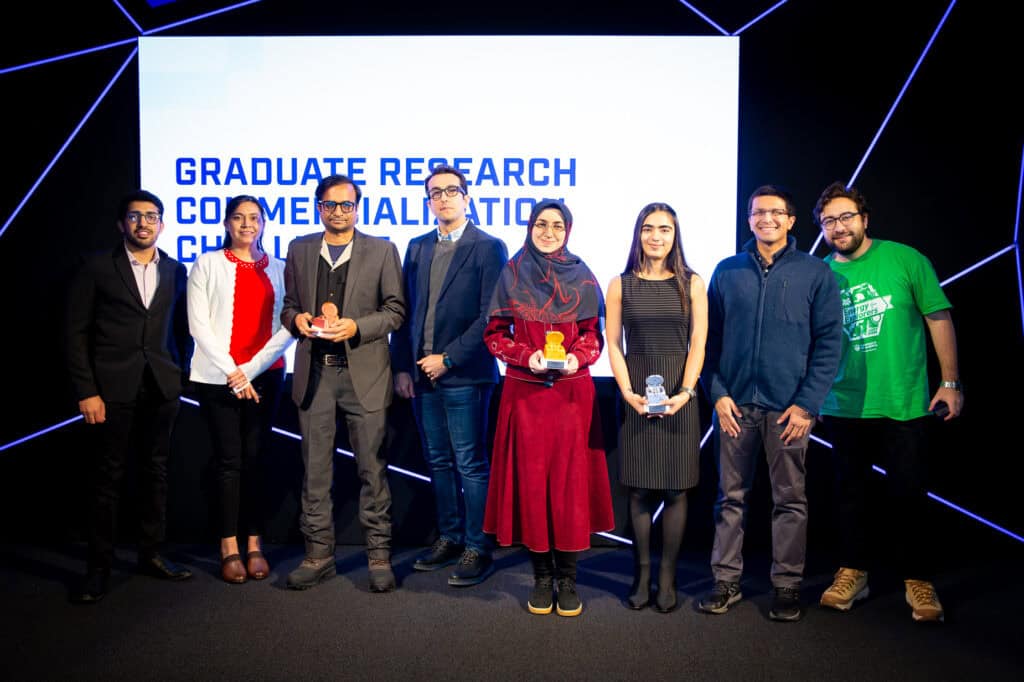
Here’s a look at what each finalist is working on.
Arushi Tandon – Silver has been used in burn care for decades because it fights infection and inflammation at the same time. Arushi wants patients to be able to breathe it in. The research includes a new production method that triples output, with the goal of an inhaled treatment for lung disease.
Hesham Elmasry – Road inspections usually mean crews on foot and lane closures. Hesham’s Automated Highway Analysis Toolkit (AHEAD) uses a single laser scan of a highway to assess lanes, markings, potholes and ruts automatically, flagging what needs attention before repairs become expensive. Tested on 22 kilometres of Alberta highway, its results came within a few centimetres of manual measurements.
Mohsen Gholizadeh – Braces and clear aligners wear away a bit of every tooth’s root. Most of the time the body repairs it, but for about 5% of patients the damage is serious, and there’s no established way to fix it. Mohsen is working on one, using a patient’s own gum cells, a gel scaffold and ultrasound to rebuild what’s been lost.
Prithviraj Vellamunda – Chemical sanitizers have to be bought, stored and handled carefully, over and over. Prithviraj’s team found another route. They use plasma and nanobubbles to make a disinfectant out of plain water, right on site and whenever it’s needed. In testing, it wiped out 99.999% of bacteria.
Reyhaneh Ababzadeh – Kids with scoliosis are X-rayed again and again so doctors can track their curve. Reyhaneh wants to cut that down. The approach pairs handheld ultrasound with a 3D scan from a tablet camera, then uses AI to bring the two together and predict which curves will worsen. Early results have come within two degrees of X-ray measurements.
Mudasar Imam – Metal 3D prints can run 40 hours or more, only to crack near the end because of uneven heating. Mudasar’s solution is an induction heater that travels with the printer, keeping the heat exactly where the metal is being laid down.
Amr Elfayoumy – Keeping AI data centres cool takes a lot of fresh water. Amr is developing a passive system that uses atmospheric water harvesting and waste heat to do the job with far less water and energy.
Jazmin Reyes Martinez – FOXN1 is a protein that plays a role in lung cancer, and there’s no approved treatment that targets it. Jazmin is using PROTACs, molecules that flag a protein for the cell to break down and can be reused many times. In testing, the compound cleared out 90% of FOXN1 in human lung cancer cells with far less drug than earlier compounds.
The judges’ questions focused on what comes after the lab, from cost and how a new tool fits into a clinic’s day to when a treatment is ready for a pharma partner and what it would take to scale. This year’s panel included:
- Brittany Sauter, PSI Engagement Lead, Edmonton Unlimited
- Emille Martinazzo Rodrigues, Program Manager, Lab2Market, University of Alberta
- Mohamed Sabek, Associate Vice-President Labour, Graduate Students’ Association
- Kingsley Igwilo, Vice-President Academic, Graduate Students’ Association
- Daniel Taylor, Engineering Incubator Operations Lead, University of Alberta
And the winners are…
Narrowing eight strong pitches down to three was no easy task for the judges, but in the end, the top spots went to:
- First place: Reyhaneh Ababzadeh, for a radiation-free approach to monitoring scoliosis
- Second place: Arushi Tandon, for an inhalable treatment for lung disease
- Third place: Mudasar Imam, for a moving heat source for metal 3D printing
In keeping with the evening’s science theme, each took home a centrifuge trophy in gold, silver or bronze.
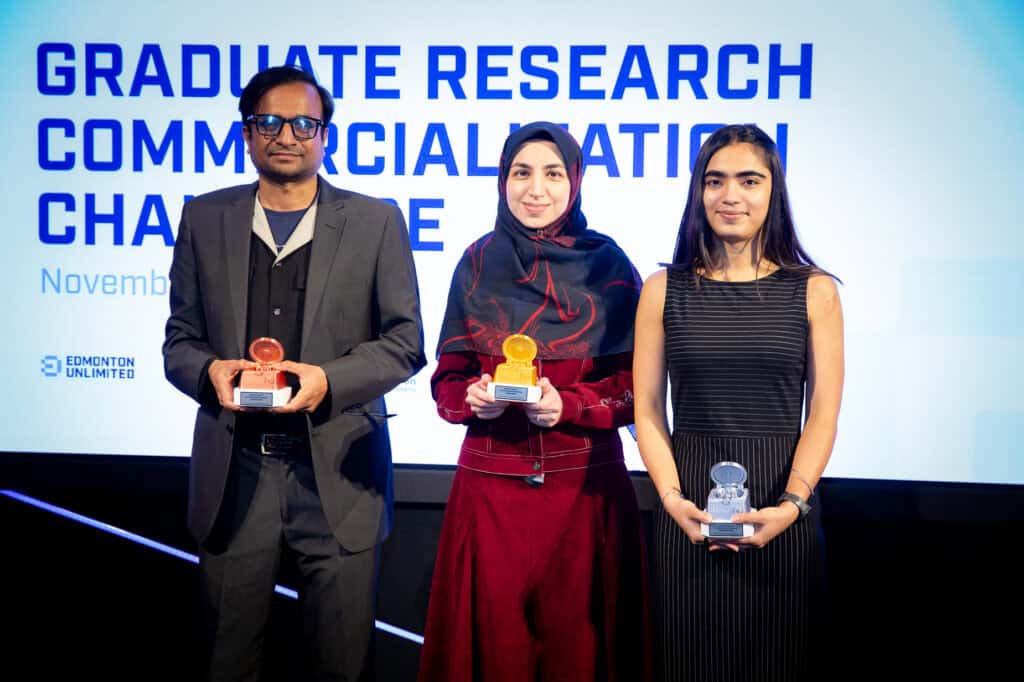
Congratulations to every finalist. Turning complex research into a short pitch for a full room is no small feat.
Eight fields, eight very different problems and one thing in common: the ambition to take research well beyond campus. Remember these names. Edmonton’s next wave of tech and innovation founders may have just made their debut!
Where to go from here.
The GRCC was designed as a first step, not a finish line. For graduate researchers curious about where their work could lead, here are two ways to stay connected:
- Studentpreneur: A 16-week summer program, from early June to mid-August, with two streams. Launch is for researchers with an idea who want to explore its potential. Grow is for those who already have an MVP and are ready to build on it. Mitacs matches funding from your post-secondary institution, so it’s a paid internship. Applications are now open, so apply today!
- Edmonton Region Research and Commercialization Day: Industry partners bring real-world challenges, researchers bring their expertise, and together they work toward solutions. It returns next year, so keep an eye out!